Wheel 101 · Part 5
Options terms to know and beginner mistakes
Options come with a lot of new words. You don't need all of them. Here are the ones that matter for the wheel, in plain English, plus the mistakes I see beginners make most.
Words to know
The basics
- Contract
- One option. It covers 100 shares of the stock.
- Put
- A contract to buy shares at a set price. When you sell one, you're agreeing to buy.
- Call
- A contract to sell shares at a set price. When you sell one, you're agreeing to sell.
- Strike
- The price in the contract ($50 in our example).
- Expiration
- The date the contract ends.
- Premium
- The cash you get paid upfront. Quoted per share, so $1.00 means $100 for one contract.
- DTE
- Days to expiration. "30 DTE" means the contract ends in 30 days.
Placing the trade
- Sell to open
- How you start a wheel trade. You're selling the contract and collecting premium.
- Buy to close
- How you end one early, by buying the same contract back. Used for the 50% take-profit rule.
- Bid and ask
- The bid is what buyers will pay. The ask is what sellers want. Selling near the middle usually gets a fairer price than selling at the bid.
- Limit order
- An order that only fills at your price or better. Use these for options instead of market orders.
- Roll
- Closing a contract and opening a new one further out in time, often at a different strike, in one trade.
What happens after
- Assigned
- You had to buy (put) or sell (call) the shares.
- Called away
- Your shares got sold because the stock finished above your call strike.
- Expired worthless
- The contract ended without being used. For a seller, that's the best case. You keep all the premium.
- Break-even
- For a put: strike minus premium. Below that price, you start losing money.
- Cost basis
- What your shares really cost you after the premiums you've collected on them.
Words that help you pick trades
- Delta
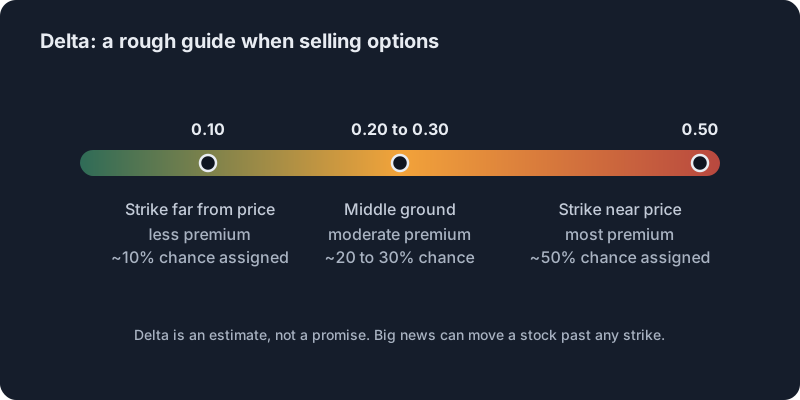
- A rough guess of the chance the option ends "in the money." A 0.20 delta is about a 20% chance.
- In the money (ITM)
- A put is in the money when the stock is below the strike. A call is in the money when the stock is above it. That's when assignment happens.
- Out of the money (OTM)
- The opposite. Most wheel trades start out of the money.
- Implied volatility (IV)
- How much the market expects the stock to move. Higher IV means bigger premium and bigger risk.
- Theta
- How much value an option loses each day as time passes. As a seller, time passing works in your favor.
Beginner mistakes
1. Picking a stock because the premium is huge
Big premium = big risk. A stock paying three times the premium of its peers usually has a reason: earnings, bad news, or wild price swings. Start with the stock, not the premium.
2. Putting too much money into one stock
If one stock is half your account and it drops 30%, that's a big hit. Spreading across several stocks keeps one bad pick from ruining a good year.
3. Selling calls below your cost and locking in a loss
When a stock drops after assignment, low call strikes pay more and look tempting. If the stock bounces, you're forced to sell at a loss. Keep your calls at or above your cost basis.
4. Panicking when assigned instead of moving to Step 2
Assignment is part of the plan, not a mistake. Once you own the shares, sell a covered call and keep the wheel turning.
5. Selling right before earnings without knowing it
Premium jumps before an earnings report because the stock could move a lot overnight. Check the earnings date before you pick an expiration.
6. Using market orders
Options can have a wide gap between bid and ask. A market order can fill at a bad price. Use limit orders near the middle.
7. Forgetting the cash is tied up
Every put you sell locks up cash until it closes or expires. Don't sell puts with money you'll need for bills next month.
Homework
Join the free Discord and post in #ask-anything:
- One stock you'd be happy to own for 5+ years.
- Why you picked it.
- Any question this lesson left you with.
We'll go through answers together.
Questions beginners ask
What delta should I use for the wheel?
There's no single right number. Lower delta means less premium and less chance of assignment. Higher delta means more premium and more assignments. Many wheel traders start somewhere between 0.20 and 0.30 and adjust from there.
What does DTE mean in options?
Days to expiration. It's how many days are left before the contract ends.
What is the most common wheel strategy mistake?
Choosing a stock because the premium is high instead of because you'd be happy to own it. When that stock drops, you're stuck holding something you never wanted.