Wheel 101 · Part 1
What is the wheel strategy?
Welcome! This is the free starter lesson. No experience needed. If a word is new, it's explained right there.
I've closed 369 options trades since April 2025, and I'll show you exactly what I do, wins and losses. Bring your questions to the free Discord. That's how we all get better.
The big idea
The wheel is a way to get paid for being patient with stocks you'd be happy to own.
You do two things, over and over:
- Get paid to agree to buy a stock at a lower price.
- If you end up owning it, get paid to agree to sell it at a higher price.
That's it. Round and round, like a wheel.
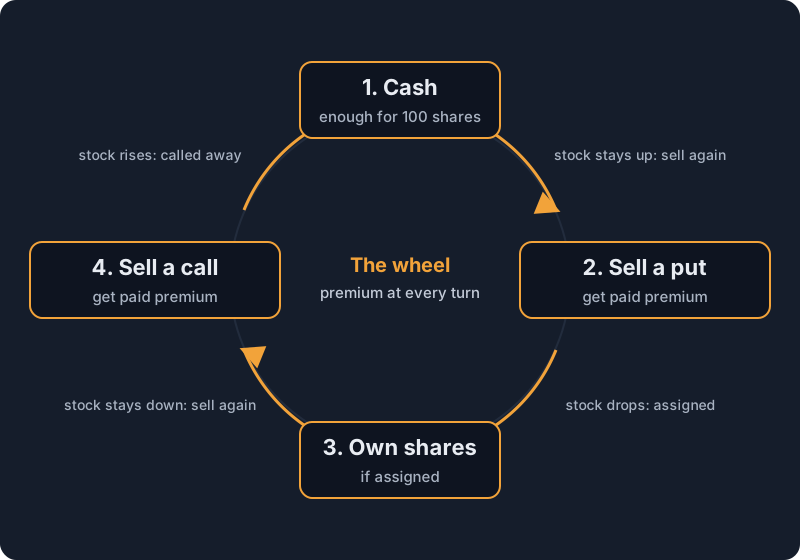
The four stops on the wheel
1. Cash. You start with enough cash to buy 100 shares of a stock you like. That's the "cash-secured" part. No borrowing.
2. Sell a put. You agree to buy 100 shares at a price you pick (the strike) by a certain date (the expiration). Someone pays you cash for that promise right away. That cash is the premium, and it's yours to keep. If the stock stays above your price, nothing else happens. You sell another put and get paid again.
3. Own the shares. If the stock drops below your price, you buy the 100 shares. That's called being assigned. You still keep the premium, so your real cost is a little lower than the price you agreed to.
4. Sell a call. Now you agree to sell your 100 shares at a higher price. Someone pays you premium again. If the stock rises above that price, your shares get sold at a profit and you're back to cash. If it doesn't, you keep the shares and sell another call.
Then it starts over. That's one trip around the wheel.
Why people like it
- You get paid upfront, every time. Premium lands in your account the day you open the trade.
- You only buy stocks you already wanted. If you get assigned, you own something you were happy to own anyway, at a lower price than when you started.
- It's slow and steady, not a lottery ticket. You're the one selling the promise, not buying it. Most weeks are boring, and boring is the goal.
- It fits around a job. You don't need to stare at charts all day. Most of my trades get set up in a few minutes and then left alone.
Why it's not free money
If a stock keeps falling, you still own it. The wheel doesn't stop losses. It just pays you while you wait.
Here's the honest trade-off:
- Your upside is capped. If a stock you sold a call on jumps 30%, you only get the gain up to your call price. You trade big wins for steady income.
- Your downside is real. If you buy shares at $50 and the stock falls to $35, you're down on paper. The premium softens it, but it won't cover a big drop.
- Cash gets tied up. One put on a $50 stock needs $5,000 set aside. That money can't do anything else while the trade is open.
I have a trade like that right now. I'll show it to you in Part 4, along with the rules I follow so one bad stock doesn't sink everything.
Who the wheel is (and isn't) for
The wheel tends to fit people who:
- Already like a few solid companies and wouldn't mind owning them for years.
- Want income more than home runs.
- Can leave cash set aside and not panic when a stock dips.
It's probably not for you if you need that cash soon, you want to get rich fast, or you'd lose sleep owning a stock that's down 15%.
What you need to get started
- A brokerage account with options approval. Most brokers ask a few questions first. Selling cash-secured puts and covered calls is usually one of the most basic approval levels.
- Enough cash for 100 shares of whatever stock you pick. A $20 stock needs $2,000. A $100 stock needs $10,000.
- A short list of stocks you'd happily own. This matters more than anything else in the strategy.
- Patience. Really.
Not ready to use real money? Paper trading (a practice account most brokers offer) is a great way to run the wheel for a few months first.
What's in the rest of Wheel 101
- This lesson: what the wheel is.
- Step 1: How to sell a cash-secured put, and what happens if you get assigned.
- Step 2: How to sell a covered call, and how one full trip adds up.
- A real wheel strategy example from my account, plus one that went against me.
- Options terms to know and beginner mistakes.
Questions beginners ask
Is the wheel strategy safe?
It's lower risk than buying options, but it isn't safe in the sense of "can't lose." Your risk is about the same as owning the stock, minus the premium you collect. If the stock drops a lot, you lose money.
How much money do you need for the wheel strategy?
Enough to buy 100 shares of the stock you choose. That can be $2,000 for a $20 stock or $50,000 for a $500 stock. Lower-priced stocks you'd still be happy to own are how most people start small.
How often do you get paid?
Every time you open a new put or call. Many people sell contracts that expire in a few weeks, so premium can come in several times a month across different stocks.
Can you do the wheel in a retirement account?
Many brokers allow cash-secured puts and covered calls in IRAs, since no borrowing is involved. Check your broker's rules for your account type.