Wheel 101 · Part 6
The wheel strategy with a small account ($5,000)
Yes, you can run the wheel with $5,000. You'll run one position at a time, on a stock priced around $50 or less.
That's not a bad thing. One position is easier to watch, easier to learn from, and it forces you to be picky. Most beginners who blow up a small account don't do it with one careful trade. They do it by squeezing in too many trades on stocks they shouldn't own.
This lesson walks through what $5,000 can actually do, how to place your first trade, the real dollar math, and what to do when it goes wrong.
What $5,000 actually buys
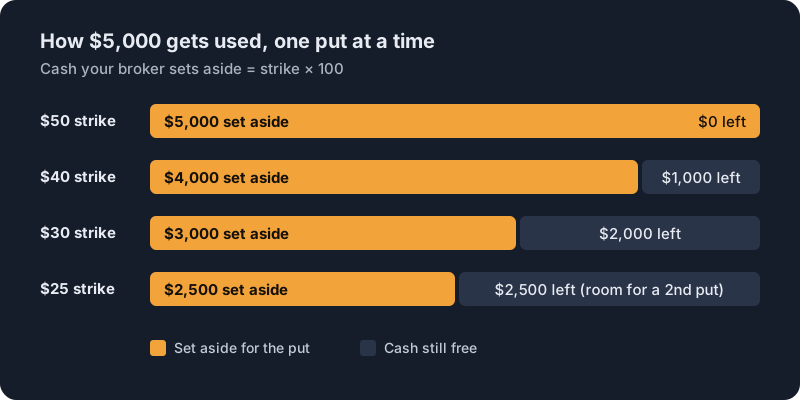
With $5,000, the highest strike you can sell a cash-secured put at is $50. One put contract covers 100 shares, so your broker sets aside the strike times 100.
| Strike | Cash set aside | Left over from $5,000 |
|---|---|---|
| $50 | $5,000 | $0 |
| $40 | $4,000 | $1,000 |
| $30 | $3,000 | $2,000 |
| $25 | $2,500 | $2,500 (room for a second put) |
For comparison, my MCD put at a $285 strike tied up $28,500. That trade isn't possible with $5,000, and that's fine. The wheel works the same way on a $40 stock as on a $285 one.
The catch: there are fewer good companies under $50 than above it. So the hardest part of a small account isn't the math. It's finding a stock you'd actually be happy to own.
Step by step: starting the wheel with $5,000
- Check your options level. Your broker has to approve you to sell cash-secured puts. At most brokers that's a low level, and many allow it in an IRA too.
- Pick one stock you'd happily own for years. Stick to big, profitable, well-known companies with busy options (tight bid/ask spreads). If you wouldn't buy 100 shares today with no options involved, skip it. Honest note: most of the stocks on my own list trade above $50, so a $5,000 account has fewer choices. A short list is better than a bad stock.
- Choose your strike. Pick a strike at or below a price you'd be glad to pay. The delta guide in Lesson 5 helps here, and check the earnings date before you pick an expiration. Leave the set-aside cash in a money market fund (I use Fidelity's SPAXX) so it earns interest while it waits.
- Sell one put. Place it as "Sell to Open," one contract, limit order at or near the middle of the bid and ask.
- Set your 50% profit order right away. As soon as the put fills, place a good-'til-canceled (GTC) order to buy it back at half of what you collected. Sold it for $0.80? Set the order at $0.40. If it fills, you keep half the premium and your cash is free early for the next put.
- Wait. Don't check it every hour. If the 50% order fills or the put expires, sell another put. If you're assigned, you now own 100 shares.
- If assigned, sell a covered call at or above your real cost. Your real cost is what you paid for the shares minus the put premium. Never sell a call below it, or you could lock in a loss. See Lesson 3.
- One contract per stock, then add stocks. My rule is one contract per stock, spread across many. With $5,000 that means one stock for now. As your account grows, add a second stock instead of a second contract on the same one.
An example with simple numbers
This one is made up with round numbers, so the math is easy to follow. A stock trades at $42 and you'd be glad to own it at $40.
- Sell one $40 put for $0.80. You collect $80 right away and set a GTC order to buy it back at $0.40. Your broker sets aside $4,000, and $1,000 stays free.
- The stock dips to $39 at expiration and you're assigned. The $0.40 order never filled. You buy 100 shares at $40. Your real cost is $39.20 a share, because the $80 premium lowers it.
- Sell one $42 covered call for $0.60. You collect $60 more.
- The stock rises to $43 and your shares are called away at $42.
| Piece | Amount |
|---|---|
| Put premium | $80 |
| Call premium | $60 |
| Share gain ($40 to $42, 100 shares) | $200 |
| Total for the full cycle | $340 |
That's $340 on $4,000 of cash over about two months, before fees. Now here's a real one.
A real one from my account: UPS with about $10,000
If you have closer to $10,000, here's a full trip around the wheel from my account in 2025. All amounts are after fees.
| Date (2025) | What I did | Cash in or out |
|---|---|---|
| Jul 7 | Sold the Aug 8 $97 put for $2.42 | +$241.32 |
| Jul 30 | Assigned: bought 100 shares at $97 | −$9,700.00 |
| Jul 31 – Nov 10 | Sold covered calls from $95 to $105, rolling them six times | +$177.18 net |
| Sep 4 and Dec 4 | Two UPS dividends | +$328.00 |
| Dec 19 | Shares called away at $100 | +$10,000.00 |
| Total profit | +$1,046.50 |
That's about $1,047 on $9,700 over five and a half months, around 11%. The put premium lowered my real cost to about $94.59 a share, so even the $95 calls I sold in the fall were above what I actually paid.
Notice where the money came from: $241 from the put, $328 from dividends, $300 from the shares, and only $177 from calls. UPS spent most of the fall below $97, so call premiums were small. That's normal. Some months the wheel pays you to wait.
This is my own trade in my own account. It isn't typical and isn't a recommendation.
What if it doesn't go to plan?
What if the stock drops hard?
Say you're assigned at $40 and the stock falls to $28. With a $39.20 cost, you're down $1,120 on paper. In a small account that's 22% of your whole $5,000, all from one stock. This is the real risk of a small account: you can't spread it out.
You don't have to sell. You can keep the shares and sell covered calls at or above your cost, even if that means small premiums for a while. My MCD trade in Lesson 4 shows what that waiting looks like. What you shouldn't do is sell calls far below your cost just to collect more premium. If they're exercised, the loss becomes real.
What if the stock shoots up?
Say it jumps from $42 to $55 before your put expires. You keep the $80, but you missed a $1,300 move you'd have caught by just buying shares. That's the trade-off of the wheel: steady small income in exchange for giving up big jumps.
What to expect from a small account
With $5,000, think of the wheel as tens of dollars a month, not hundreds. In the example above, the put paid $80 on $4,000, which is 2% for one month. Many months will pay less than that, and some cycles will lose money.
If you see a stock under $50 paying a much bigger premium, that's the market telling you it expects a big move. High premium means high risk, not free money.
The real payoff of starting small is the practice. You learn how assignment feels, how to stay calm when a stock drops, and how to follow your rules, while the dollars at risk are still small.
Small-account mistakes to avoid
1. Picking a stock because it's cheap
A $6 stock fits your account, but cheap stocks are often cheap for a reason. Choose the business first, then check if the price fits.
2. Chasing the biggest premium
The highest-paying puts under $50 are usually on the most volatile stocks. Those are the ones most likely to drop 30%.
3. Using margin to sell more puts
Margin lets you sell puts you can't fully cover. If several are assigned at once, you can be forced to sell at the worst time. Keep it cash-secured.
4. Doubling up on one stock
When a premium looks good, it's tempting to sell a second contract on the same stock. Don't. One contract per stock means one bad company can't sink you.
5. Giving up after one bad cycle
One stock going against you is normal. Judge your results over many cycles, not one.
Questions beginners ask
Can I run the wheel with $1,000 or $2,000?
Technically, on stocks under $10 or $20. But very few solid businesses trade that low, and one bad stock can take a big bite. Many people save up to $5,000 first and paper trade in the meantime.
How much can I make with $5,000?
Realistically, tens of dollars a month, and some months you'll lose. Anyone promising $500 a month on $5,000 is describing a lot of risk.
Should I use margin to sell more puts?
Not when you're starting out. Cash-secured means you can always afford the shares if you're assigned. Margin removes that safety net.
Can I run the wheel in an IRA?
At many brokers, yes. Cash-secured puts and covered calls are often allowed in IRAs. Check your broker's options approval levels.
What if I'm assigned and the stock keeps falling?
You can hold the shares and sell covered calls at or above your cost while you wait. You can also sell the shares and take the loss. Either way, decide based on whether you still want to own the business.